Walk down the page to follow one scan from the archive to a prediction. Scrub, switch cohorts, and toggle the attention map as you go.
Stage 1 · The data
PPMI: three cohorts
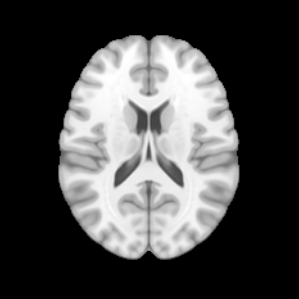
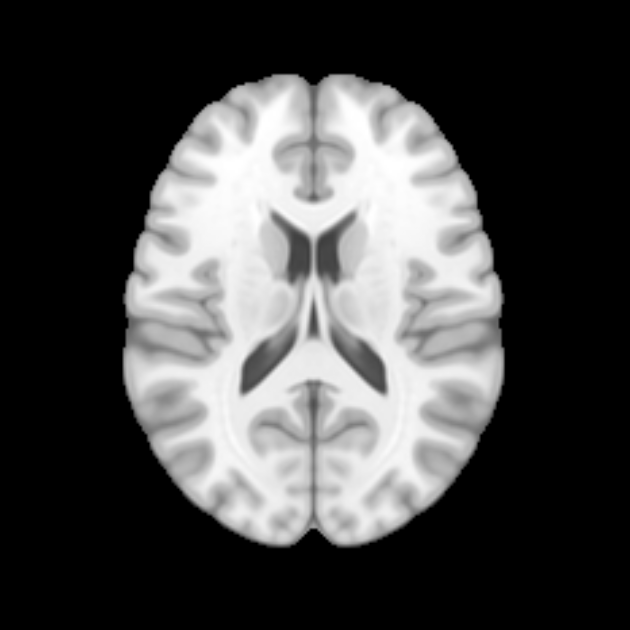
Scans come from the Parkinson's Progression Markers Initiative (PPMI): T1-weighted structural MRI from three groups the model learns to separate. Access needs a data-use agreement, so no raw scans are hosted here; the brain shown throughout is the open MNI152 template, for illustration.
Control
No Parkinson's. The healthy baseline.
Prodromal
Early, at-risk stage, before clinical diagnosis.
Parkinson's (PD)
Clinically diagnosed Parkinson's disease.
Stage 2 · One scan
A 3D volume → the middle axial slice
Each scan is a 3D stack of slices. Rather than process the whole volume, the model takes the middle axial slice: one representative 2D image. Scrub the stack: the highlighted frame is the slice that goes forward.
slice 7 / 13 ← middle slice (used)
Stage 3 · Preprocess
Preparing the slice
Before the network sees it, the slice is standardised so every scan is comparable.
Register → MNI PD25
→
Middle axial slice
→
Resize 224×224
→
Normalize µ=0.5, σ=0.5
→
Augment (train)
Volumes are registered to the MNI PD25-T1MPRAGE (1 mm) template in MATLAB; the single-channel slice is duplicated across RGB for ResNet18. Training-only augmentation: rotation ±10°, horizontal flip, colour jitter, and affine shifts.
Stage 4 · CNN
ResNet18 reads local structure
The 2D slice passes through ResNet18. Each block shrinks the image spatially and deepens it into more feature channels, capturing local structure: edges, tissue boundaries, shapes.
input224² · 3ch
→
conv156² · 64
→
block228² · 128
→
block314² · 256
→
block47² · 512
ResNet18 (ImageNet-pretrained), with the fully-connected head removed, ending in a 512-channel feature map (7×7×512). The stacks show feature maps shrinking spatially and deepening in channels. Hover a layer to watch its maps recompute.
Stage 5 · Transformer
The Transformer relates distant regions
The feature map is flattened into a sequence of tokens (one per spatial position), given positional encodings, and passed to a Transformer encoder (6 layers, 8 heads). Self-attention lets any region influence any other: long-range relationships a CNN alone can't capture.
The 7×7×512 feature map is flattened to 49 tokens (d = 512) with positional encodings, then passed through 6 encoder blocks, each with multi-head self-attention (8 heads) → Add & Norm → feed-forward (dropout) → Add & Norm. Global average pooling (no CLS token) → dropout p = 0.5 → fully-connected head → the three classes.
Stage 6 · Prediction & attention
The verdict, and where it looked
A classification head turns the Transformer's output into three probabilities. Pick an example cohort to see a typical prediction, and toggle the attention map to see which regions of the slice drove it.
Control82%
Prodromal12%
PD6%
Predicted: Control
80.5%
Accuracy
80.5%
Precision
79.9%
Recall
0.80
F1
0.84
AUC-ROC
Benchmark: hybrid vs 3D CNN baselines (PPMI test set, %)
CNN-Transformer (ours)3D VGG163D DenseNet121
Slightly lower precision, but clearly higher recall and F1, the balance that matters most in a clinical screen. Axis 70–85%.
Next step: region-level interpretability, showing which brain area drives each prediction. The published model reports classification only and notes this as future work.
The paper
A.-N. Khushbu, Z. Yang, Y. Liu, and X. Zhang · 2024 4th International Conference on Industrial Automation, Robotics and Control Engineering (IARCE), pp. 307–311, 2024.
@inproceedings{khushbu2024parkinsons,
  title     = {{P}arkinson's Disease Recognition Using Hybrid {CNN-Transformer} Model},
  author    = {Khushbu, Al-Nahiyan and Yang, Z. and Liu, Y. and Zhang, X.},
  booktitle = {2024 4th International Conference on Industrial Automation, Robotics and Control Engineering (IARCE)},
  pages     = {307--311},
  year      = {2024},
  publisher = {IEEE},
  doi       = {10.1109/IARCE64300.2024.00064}
}TY - CPAPER
TI - Parkinson's Disease Recognition Using Hybrid CNN-Transformer Model
AU - Khushbu, A.-N.
AU - Yang, Z.
AU - Liu, Y.
AU - Zhang, X.
T2 - 2024 4th International Conference on Industrial Automation, Robotics and Control Engineering (IARCE)
PY - 2024
SP - 307
EP - 311
PB - IEEE
DO - 10.1109/IARCE64300.2024.00064
UR - https://doi.org/10.1109/IARCE64300.2024.00064
KW - Parkinson's disease
KW - CNN-Transformer
KW - medical imaging
KW - deep learning
KW - 2D MRI
AB - This paper presents a novel hybrid architecture combining Convolutional Neural Networks (CNNs) with Transformer attention mechanisms for Parkinson's disease classification using 2D structural MRI. The proposed model leverages the feature extraction capabilities of CNNs while incorporating the global context modeling of Transformers to achieve improved classification performance. Our lightweight model provides rapid pre-screening capabilities for early PD detection, achieving 80.51% accuracy on structural brain MRI data. The hybrid approach demonstrates the effectiveness of combining local feature extraction with global attention mechanisms for medical image analysis, offering a computationally efficient solution suitable for clinical deployment in resource-constrained settings.
ER -